
Welcome! Introduction and Instructions
The RBLM Sensorimotor Needs Inventory has been designed for students with visual impairments, and/or autism, multiple impairments, deaf and hard-of-hearing, multiple disabilities, and/or behavior issues. This inventory will assist in planning interventions. An email will be sent to the tester’s email address at the completion of the Inventory. The links for the activities will be on the email and the activities will be printable from those links.
It is imperative before attempting and scoring the Sensorimotor Needs Inventory, that the course RBLM: Meeting the Sensorimotor Needs for Students with VI and/or ASD, MI, DHH, MD and behavior is completed. See https://rblm.teachable.com
So why a Sensorimotor Needs Inventory? Much of the desire to create this Inventory came from concerns about the “behaviors” of students. It is best to first develop a holistic understanding of what might be called behaviors, remembering to consider the whole child before attempting to extinguish one particular behavior. Upon identifying the presence of sensory motor issues, it is crucial to consider their potential impact on behavior. With this insight, it becomes possible to develop an intervention plan tailored to the student’s needs. Incorporating an understanding of these issues into the intervention approach can help to lessen their influence on behavior and promote positive outcomes. Therefore, careful consideration and assessment of sensory motor issues are essential to develop effective intervention plans that address the whole spectrum of an individual’s needs.
This Inventory is not seeking a diagnosis, but rather striving to understand how children may exhibit sensory motor delays or needs. For instance, motor instability and sensory insecurity can lead to anxiety. As students become more sensory and motor competent, their anxiety decreases, and their behaviors improve. So, intervention then involves encouraging sensory motor development and reducing anxiety to improve overall development and competence.
Not all activities in Ready Bodies, Learning Minds; Cultivating the Complete Child will be listed here. Some do not apply to these students. Some of the activities listed may be self-explanatory, while others may require modification. If modifications are necessary, they are suggested and printed in red at the top of each linked activity page. Additionally, there is an appendix for special situations not covered in the RBLM book. These appendix items are labeled as A1, A2, and so on.
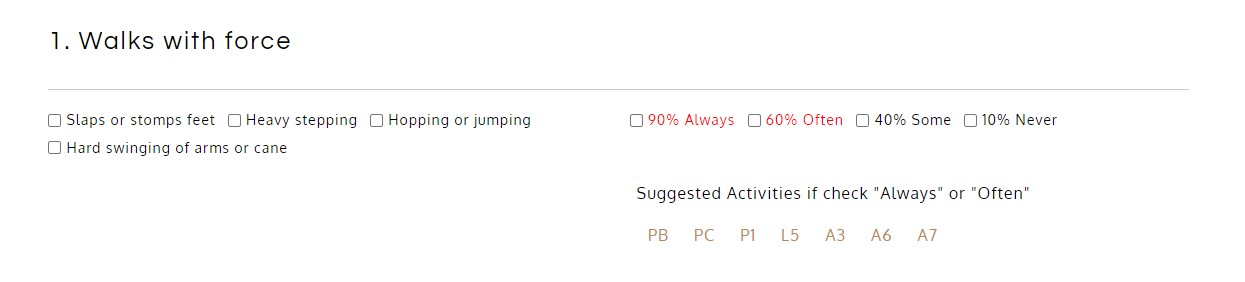
There are seven major headings on the Inventory, such as Vestibular, Proprioceptive, or Oral. Each of these major headings has multiple subheadings listed as 1, 2, 3, etc. These subheadings are categories of responses. Under each subheading, there are several descriptive options available. These descriptive options have no scoring value but are simply a description of the student’s behavior. The evaluator must check one or more of these options if they observe the student demonstrating the corresponding behaviors.
During an evaluation, the examiner will choose from five categories of occurrence:
~”always” (90% of the time)
~”often” (60% of the time)
~”some” (40% of the time)
~”never” (10% of the time)
~or occasionally the option “refuses.”
-
If “always” (90%) or “often” (60%) is chosen this describes the activity as persistent, the score then goes in the red zone, and the links to the intervention activities will be below those checkmarks.
-
If a response of “some” (40%) or “never” (10%) is selected in any question, there may be no need to pursue the recommended activities. None will be listed below those checkmarks.
-
However, this rule does not apply to three specific questions: Vestibular #1, Vestibular #2 and Proprioceptive #10, where a response of “never” or “refuses” is flagged as a concern. In such cases, intervention is recommended, and corresponding activities are listed below those checkmarks.
After finishing the Sensorimotor Needs Inventory, a summary page will be scored. Each major category, such as Vestibular, is scored by indicating the number of questions that were assessed at 90%, 60%, 40%, and 10%, or were refused. It is then easy to identify the proportion of the major category that has scored in the red.
For instance, if more than half of the 8 Vestibular questions have been marked in red, then this area of intervention might be given high priority. From this information about all of the major categories, an intervention plan can be created.
An email will be sent to the tester’s email address at the completion of the Inventory. The links for the activities will be on the email and the activities will be printable from those links.